2026-09-20
Full Mouth Dental Implants After Prolonged Denture Use: Candidacy, Types, and Procedures
Discover full mouth dental implant options after long-term denture use. Learn how jawbone resorption is evaluated and how treatments like bone grafting and All-on-X restore biting function.
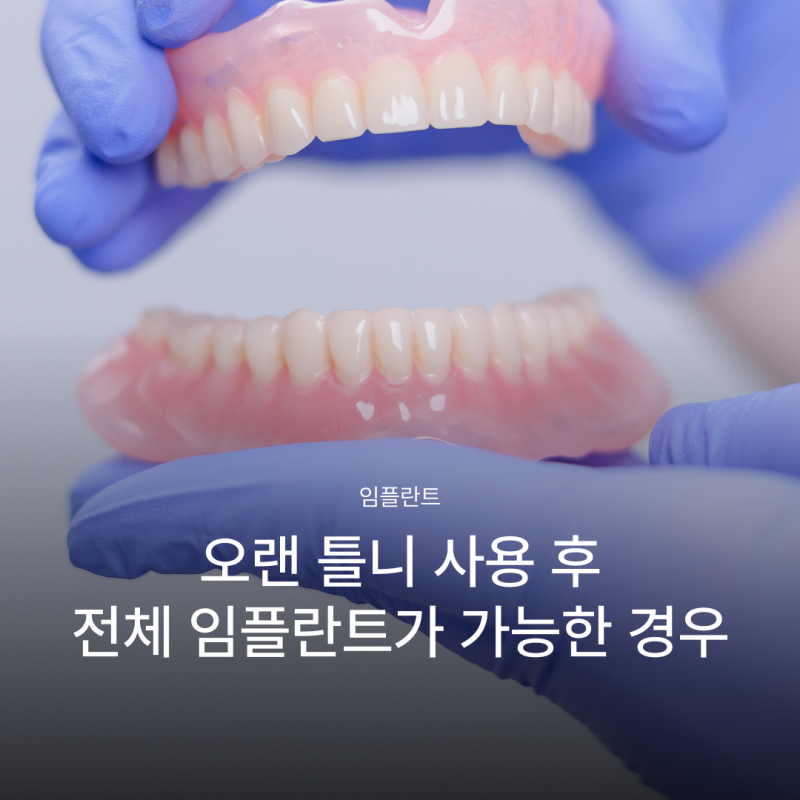
Full Mouth Dental Implants After Prolonged Denture Use: Candidacy, Types, and Procedures
Hello.
Your journey to a comfortable daily life starts with Haruplant Dental Clinic.
Many patients who have worn dentures for a long time visit our clinic after deciding, "It's finally time to get full mouth dental implants."
This decision often comes after dealing with persistent pain from dentures pressing on the gums, a lingering foreign-body sensation, and the continuous discomfort of teeth shifting whenever they chew.
Among these patients, many have worn dentures for decades.
In such cases, before deciding on implant-supported overdentures or full mouth implants, there is one crucial factor that must be evaluated first:
The condition of the jawbone, which progressively resorbs during the period teeth are missing.
Prolonged denture wear can cause severe alveolar bone resorption, sometimes making conventional implant placement challenging.
Furthermore, the remaining volume of jawbone directly influences the complexity and methodology of your treatment plan.
For those unfamiliar with the concept,
full mouth dental implants refer to a restorative treatment that reconstructs the entire upper or lower dental arch using dental implants and fixed or removable prosthetics when most or all natural teeth are missing or non-functional.
Depending on your oral condition, various modalities can be considered, including full-arch fixed bridges, implant-supported overdentures, and All-on-X solutions.
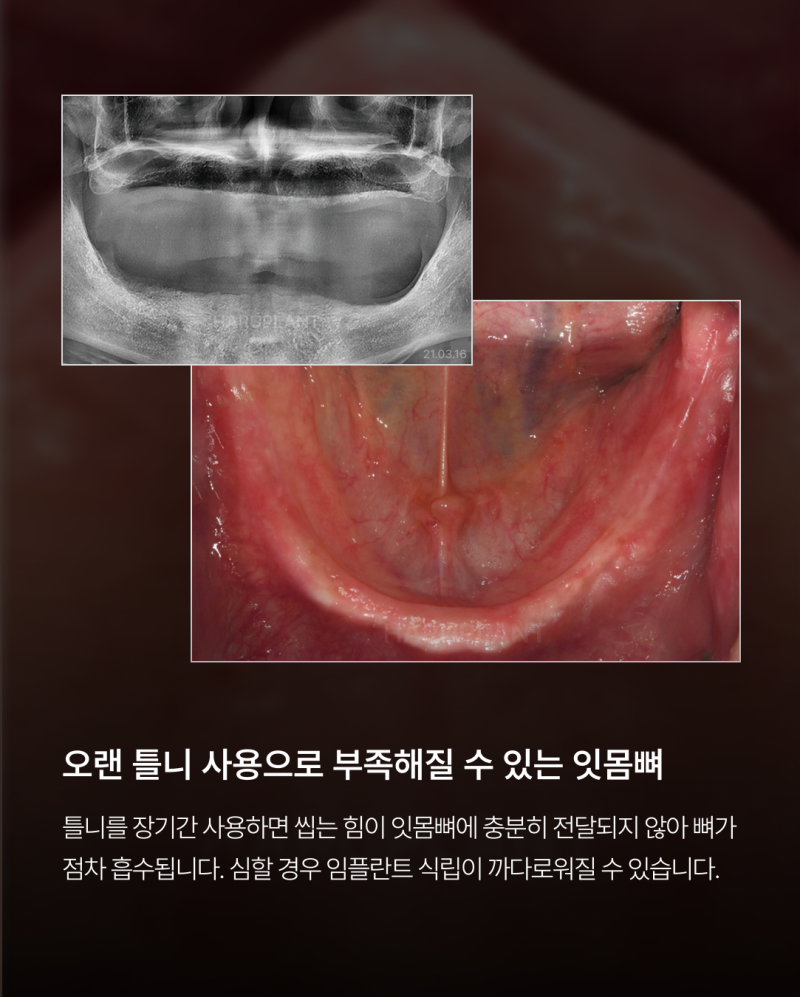
After Prolonged Denture Wear, Jawbone Condition Must Be Checked First
When wearing removable dentures long-term, biting forces are not adequately transmitted to the underlying jawbone, leading to the gradual resorption of the alveolar bone.
Additionally, repetitive pressure from dentures onto the gingival tissues can alter the contour of the gums.
Over time, this causes dentures to lose their proper fit and become increasingly loose.
Patients experiencing this often worry: "With so much bone lost, is it still possible to get implants?"
That is precisely why it is essential to accurately measure how much jawbone remains and determine where implants can be securely anchored.
While deficits in bone height and width increase surgical complexity,
an optimal and viable treatment plan can still be established through meticulous digital diagnostics and advanced clinical expertise.
Candidacy for Full Mouth Implants ① Adequate Remaining Jawbone
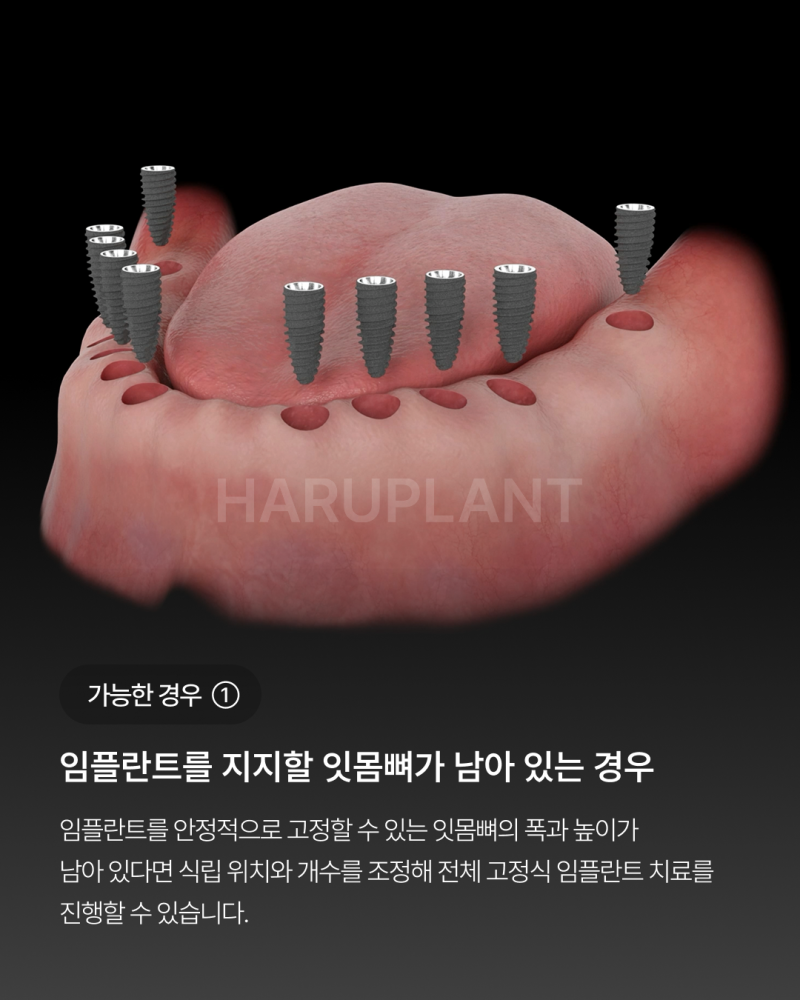
If the width and height of the alveolar bone are sufficient to achieve solid primary stability,
a full-arch fixed implant restoration can be planned.
In this scenario, accurately assessing the bone architecture and key anatomical landmarks, such as the inferior alveolar nerve, is paramount.
Even with identical bone conditions, outcomes can vary significantly depending on diagnostic accuracy and treatment planning.
Advanced digital diagnostic tools, such as 3D CT scans and 3D intraoral scanners, play a critical role in thoroughly evaluating the oral cavity.
Implant surgery is not simply about placing as many fixtures as possible;
it requires calculating exactly how many implants are needed and precisely where they should be positioned to reliably support the full-arch prosthesis.
In practice, full mouth implant rehabilitation is not just replacing missing teeth individually—it is re-engineering the biomechanical chewing structure of the entire mouth.
Even with ample residual bone, evaluating implant coordinates, prosthetic vertical dimension, and the distribution of occlusal forces remains essential.
Candidacy for Full Mouth Implants ② Insufficient Bone That Can Be Rebuilt
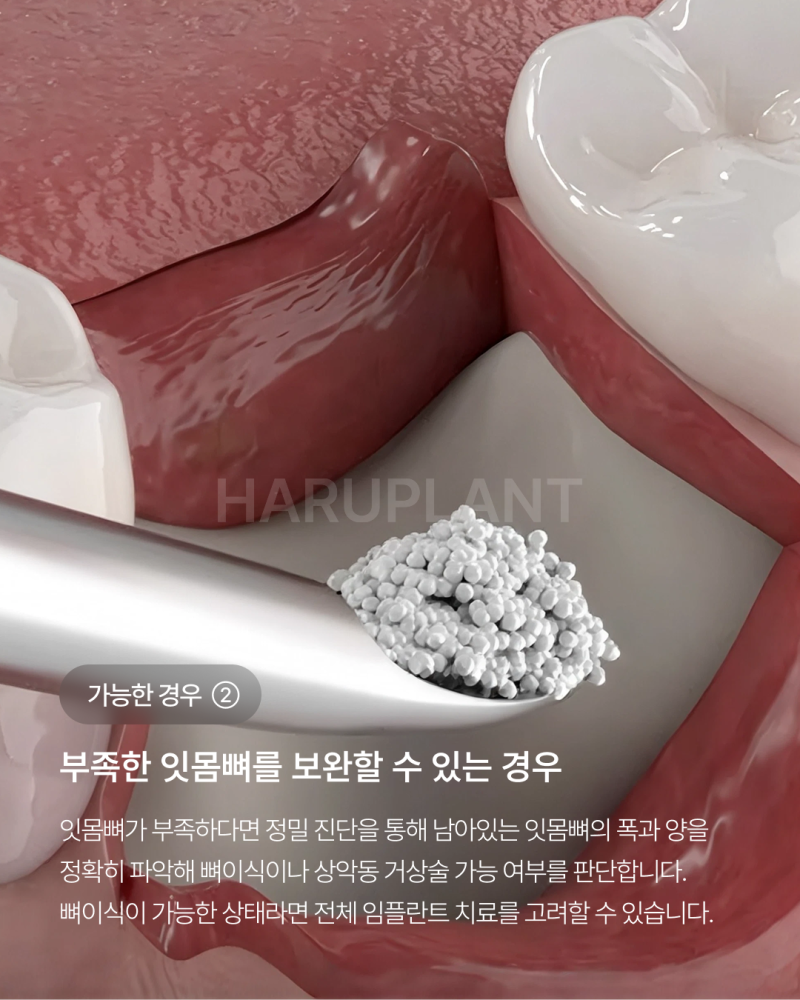
What happens if diagnostic imaging shows insufficient bone?
Having a depleted jawbone does not rule out full mouth implants.
Through precise 3D diagnostics, we evaluate the exact dimensions and volume of remaining bone to see if bone grafting or sinus augmentation can reconstruct the deficient site.
If bone grafting can establish a solid foundation for the implants, the graft is performed before or concurrently with implant placement.
During this stage, we comprehensively determine whether a fully fixed prosthetic, an implant-retained overdenture, or another solution is most suitable,
selecting the specific implant modality that aligns best with the patient's oral anatomy and expectations.
Every patient presents a unique clinical picture, from residual bone geometry and oral biomechanics to underlying systemic health.
Candidacy for Full Mouth Implants ③ Severe Alveolar Bone Resorption
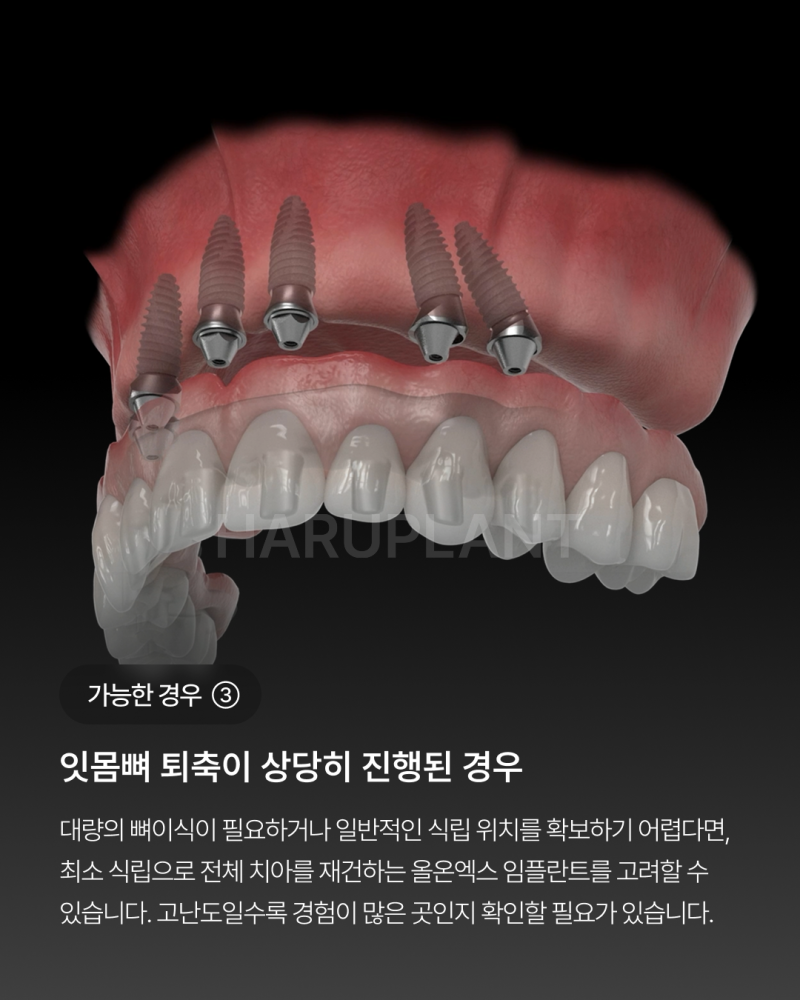
In cases of advanced bone resorption, standard implant sites may not be viable, or massive bone grafting procedures would be required.
Severe bone loss can also place the alveolar crest dangerously close to the inferior alveolar nerve, making standard vertical placement difficult.
Patients facing these challenges may have felt overwhelmed by extensive bone grafting or been told elsewhere that implants were not an option.
In these complex situations, All-on-X implants can serve as a dependable alternative by rehabilitating the complete arch with a minimal number of fixtures.
All-on-X utilizes strategic angled placement in dense residual bone to support a full-arch restoration using fewer implants.
Specifically, a minimal number of implants are anchored and joined to a rigid titanium-reinforced framework supporting the full set of prosthetic teeth.
This treatment combines the comprehensive coverage benefits of a denture with the rigid stability and biting strength of permanent implants.
Because All-on-X relies on limited residual bone to distribute full occlusal loads, angulation, positioning, and prosthetic engineering must be calculated with extreme precision. It is vital to select a clinic with extensive experience in All-on-X and full-arch rehabilitations.
Ultimately, whether an implant overdenture, All-on-X, or a traditional full fixed bridge is best depends directly on your bone status.
Digital Diagnostics and Proven Clinical Expertise for Long-Lasting Full Mouth Implants
Even if long-term denture use has caused bone loss,
a predictable treatment plan can be designed by accurately assessing residual bone volume and reconstructive potential.
The critical factor is conducting a comprehensive 3D evaluation of the oral structures to determine surgical boundaries and feasibility.
Haruplant Dental Clinic utilizes advanced low-dose 3D CT systems, 3D intraoral scanners, and 3D facial scanners to meticulously assess bone volume and plan optimal implant trajectories based on objective data.
Led by Chief Director Seong-man Byun (Seoul National University alumnus with 27 years of clinical experience) and a surgical team seasoned in complex full-arch reconstructions,
we design personalized treatment protocols balancing both jawbone architecture and overall systemic health.
If you are considering transitioning from long-term dentures to full mouth implants,
start with a thorough diagnostic assessment to see which full-arch restoration matches your oral anatomy.
Comparing options—including implant-supported overdentures, All-on-X, and fixed bridges—will help you identify the most realistic, comfortable, and durable treatment plan.
We hope this guide provides clarity as you consider your next steps toward restorative treatment.
For full mouth dental implants, visit Haruplant Dental Clinic in Gangnam.

Frequently Asked Questions
What exactly are full mouth dental implants?
Full mouth dental implants restore complete dental function across the entire arch using implants and fixed or removable prosthetics when most or all natural teeth are absent or failing. Rather than replacing each missing tooth individually, this treatment re-engineers the entire occlusal and masticatory structure using fixed bridges, implant overdentures, or All-on-X systems.
Can I get implants if I have bone loss from wearing dentures for years?
Yes. Deficient bone can often be restored using targeted bone grafting or sinus augmentation. By utilizing precision diagnostics to assess remaining bone dimensions and rebuilding the foundational ridge, implants can be firmly anchored according to your overall systemic health and oral condition.
What if I was told I don't have enough bone for implants?
All-on-X implants can be an effective alternative. Even in cases of significant bone loss, All-on-X maximizes residual bone volume by placing a minimal number of angled implants connected to a titanium-reinforced full-arch prosthesis, bypassing the need for extensive bone grafting or risks near nerve canals.
What diagnostic steps are taken before full mouth implant surgery?
Patients undergo a comprehensive diagnostic workup using low-dose 3D CT scanners and 3D intraoral scanners. These tools map bone height, width, and nerve pathways in three dimensions, allowing clinicians to calculate precise implant trajectories, prosthetic vertical dimensions, and chewing force distributions.